 Rewards infrastructure for Africa
African Employee Benefits Benchmarks: How Does Your Programme Compare?
What are the best African companies spending on benefits — and what does best-in-class look like? The benchmarks every HR leader needs across Nigeria, Kenya, and Ghana.
Abby Sotomiwa
Co-Founder & CEO, RibiRewards

African Employee Benefits Benchmarks: How Does Your Programme Compare?
What are the best African companies actually spending on benefits — and what does a best-in-class benefits programme look like across Nigeria, Kenya, and Ghana? The benchmarks every HR leader should know. For more on this, see our piece on What Gen Z African Employees Actually Want From Their Benefits Package.
Why Benchmarking Matters
HR teams that build benefits programmes in isolation risk two opposite failure modes: over-spending on benefits that don't move the needle, or under-investing and losing talent to competitors who got it right. Benchmarking against the market gives you a reference point — not to copy it blindly, but to understand where you sit and make informed decisions. For more on this, see our piece on Why 78% of African Professionals Say Benefits Influence Their Job Decisions.
African benefits benchmarking data has historically been hard to come by. Most published data reflects European or North American norms that don't translate directly to the cost structures, cultural priorities, and infrastructure realities of African markets. What follows draws on patterns from companies across Nigeria, Kenya, and Ghana operating at different scales.
Benefits Spend as a Percentage of Payroll
Across African companies with structured benefits programmes, total benefits spend — excluding statutory contributions — typically falls in the following ranges by company maturity:
- Early-stage startups (under 50 employees): 5–10% of payroll on non-statutory benefits. Budget is constrained; focus is on high-impact, low-cost categories (health, meal, data).
- Growth-stage companies (50–200 employees): 10–18% of payroll. Broader category coverage, beginning to include L&D and lifestyle benefits.
- Established companies (200+ employees): 15–25% of payroll. Full category coverage with flexibility options, often including family support and professional development.
- Multinationals operating in Africa: 20–30% of payroll, often benchmarked to global standards with local adaptations.
Category-Level Benchmarks: Nigeria
- Meal allowance: ₦8,000–₦25,000/month. Median among tech companies: ~₦15,000.
- Transport allowance: ₦10,000–₦40,000/month. Varies significantly by role and commute distance.
- HMO contribution (top-up): ₦5,000–₦20,000/month above base group plan.
- L&D stipend: ₦10,000–₦30,000/month. Median among tech companies: ~₦15,000.
- Data bundle (remote workers): ₦5,000–₦12,000/month.
- School fee contribution: ₦20,000–₦80,000/term. Typically reserved for mid-senior levels.
Category-Level Benchmarks: Kenya
- Meal allowance: KES 2,000–KES 8,000/month.
- Transport allowance: KES 3,000–KES 10,000/month.
- Private health insurance top-up: KES 2,000–KES 6,000/month.
- L&D stipend: KES 2,000–KES 8,000/month.
- Data bundle: KES 1,500–KES 4,000/month.
What Best-in-Class Looks Like
The companies consistently winning talent wars across Africa share a common benefits profile: comprehensive health coverage (not just statutory), a daily-use benefit (meal or transport), a growth benefit (L&D), and at least one family or lifestyle benefit. The total monthly benefit value per employee typically sits at 15–25% of monthly salary.
Critically, best-in-class companies don't just spend more — they communicate more. Employees at top-performing companies are more likely to be able to accurately describe their benefits package and its value. Communication and delivery quality matter as much as budget.
The Utilisation Benchmark
Spend benchmarks matter less than utilisation benchmarks. A programme that allocates ₦20,000 per month and achieves 40% utilisation delivers less value than a programme that allocates ₦12,000 and achieves 90% utilisation.
Best-in-class utilisation targets for African benefits programmes: 80–90% monthly across active benefit categories. Anything below 60% warrants an immediate review of communication, redemption experience, and benefit relevance.
Using RibiRewards Data
As Africa's leading employee benefits platform, RibiRewards aggregates anonymised utilisation and spend data across our client base — providing HR teams with real-time benchmarking against comparable companies in their market. If you're a current client, this data is available in your analytics dashboard. If you're evaluating RibiRewards, ask for a benchmarking report as part of your demo.
Related reading
Abby Sotomiwa
Co-Founder & CEO, RibiRewards
Building rewards and recognition infrastructure for African and diaspora markets.
Africa HR Insights
100 chart-driven data reports on employee rewards, recognition benchmarks, and year-end gifting across African markets — published weekly by RibiRewards.
Ready to start rewarding your team properly?
One dashboard, every African market, every reward type. Book a 20-minute call and we'll tailor the platform to your team.
 PRODUCT
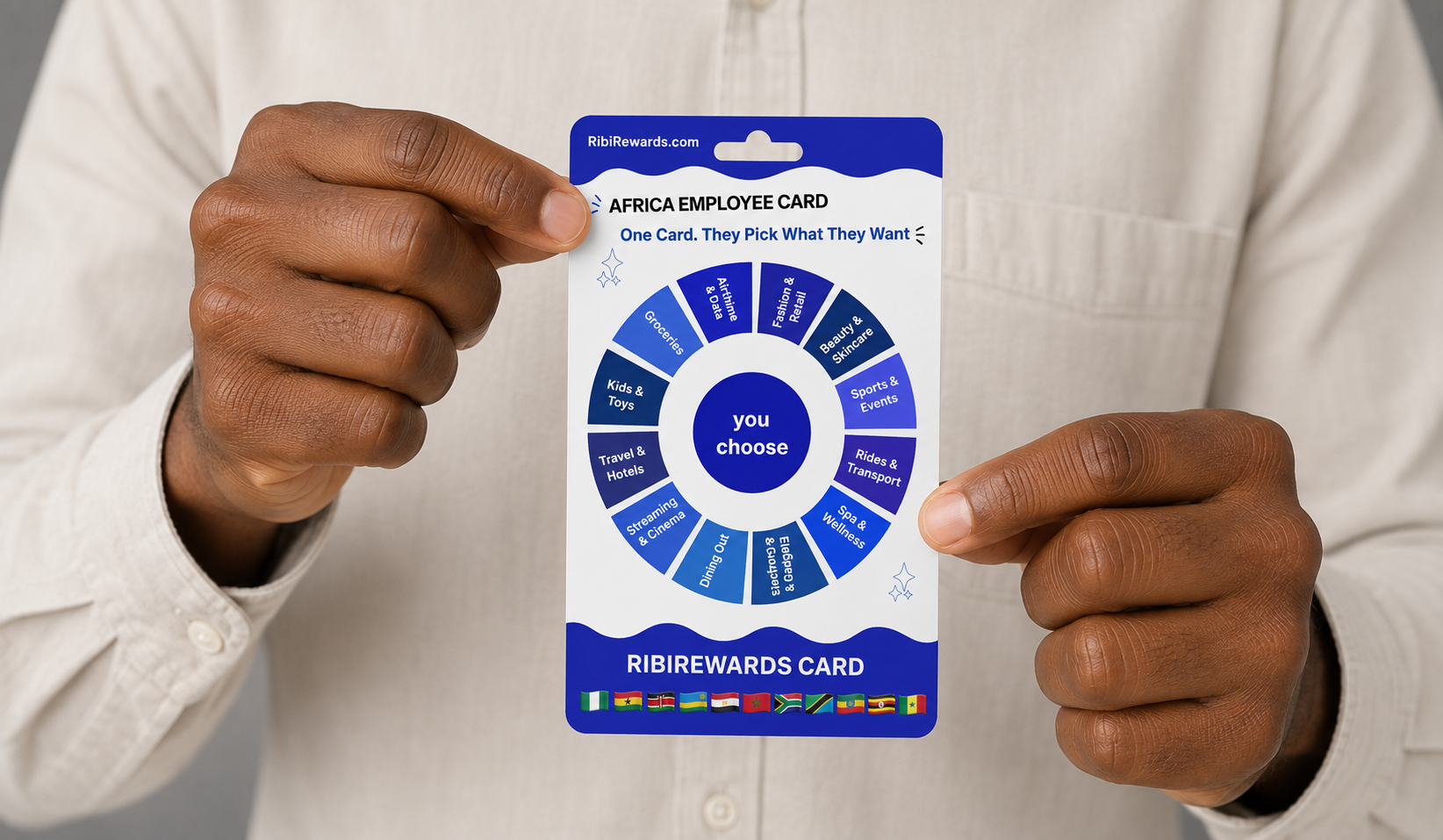
We Just Launched RewardsCard on Product Hunt
RewardsCard is Africa's rewards and gifting infrastructure in one card — HR teams send it, recipients pick what they actually want from a real catalogue, live across 29 countries. Here's why we built it, and where to find the launch.
 SEASONAL GIFTING
Why December Gifting Planning Should Start in August
Companies that lock in their December gifting plan months ahead get first pick of pricing, delivery slots and card designs. Here's why the scramble every December is avoidable — and what starting early actually looks like.
 CHOICE REWARDS
One Gift, Infinite Choices: Solving Multi-Country December Gifting
Sending the same fruit basket to a team spread across five countries isn't a gift plan. Here's how choice-based rewards let each person pick what actually matters to them, fulfilled properly in their own market.