 Rewards infrastructure for Africa
Benefits vs Salary Increase: Which One Retains African Employees Better?
Should you raise salaries or invest in benefits when budget is limited? The data-driven answer for African companies — and a framework for making the right call.
Abby Sotomiwa
Co-Founder & CEO, RibiRewards

Benefits vs Salary Increase: Which One Retains African Employees Better?
When budget is limited, should you raise salaries or invest in benefits? The answer is more nuanced than you think — and it depends on where your team is on the compensation curve.
The Question Every African CEO and CFO Is Asking
With inflation eroding real wages and the talent market intensely competitive, African companies face a persistent dilemma: when resources are constrained, do you increase salaries or invest in benefits? The intuitive answer — raise salaries — is often wrong, or at least incomplete.
When Salary Increases Are the Right Answer
If your compensation is meaningfully below market rate — more than 15–20% below what employees can command elsewhere — benefits programmes will not compensate for the gap. Employees who feel underpaid will notice that the gap exists, and no amount of meal credits or gym access will resolve the underlying grievance.
In this scenario, bring compensation to market first. Once you're competitive on base salary, benefits become the differentiator that creates loyalty beyond what compensation alone can achieve.
When Benefits Investment Is More Impactful
Once compensation is market-competitive, incremental salary increases have diminishing returns as retention tools. The 10th percentile increase beyond market rate doesn't generate 10% more loyalty — it generates a new baseline expectation that will need to be maintained indefinitely.
Benefits, by contrast, address dimensions of the employee experience that money alone doesn't reach: daily practical support, family wellbeing, professional growth, and the emotional experience of being cared for as a whole person.
The Tax Efficiency Argument
In many African jurisdictions, there are benefit categories with more favourable tax treatment than equivalent salary. The exact treatment varies by market and benefit type — this requires local tax advice — but in principle, structured benefits can deliver more net value to employees per naira or shilling of company cost than equivalent cash compensation.
The Psychological Economics of Each Approach
A salary increase becomes the new normal within weeks. The hedonic adaptation is fast — employees adjust their spending patterns upward and the raise stops feeling special. A monthly meal allowance, by contrast, is felt as a benefit every time it's used — the employer's role in making lunch more affordable is experiential and repeated.
This difference in psychological accounting is significant. Benefits create a recurring sense of employer investment. Salary increases create a one-time satisfaction spike that fades quickly.
The Practical Framework
Use this framework when making the decision:
- If compensation is below market: fix salary first, then add benefits
- If compensation is at market: invest in benefits before chasing above-market salary
- If compensation is above market: benefits are your primary retention differentiator
- Always: communicate your benefits clearly — unreceived value doesn't retain anyone
Related reading
Abby Sotomiwa
Co-Founder & CEO, RibiRewards
Building rewards and recognition infrastructure for African and diaspora markets.
Africa HR Insights
100 chart-driven data reports on employee rewards, recognition benchmarks, and year-end gifting across African markets — published weekly by RibiRewards.
Ready to start rewarding your team properly?
One dashboard, every African market, every reward type. Book a 20-minute call and we'll tailor the platform to your team.
 PRODUCT
We Just Launched RewardsCard on Product Hunt
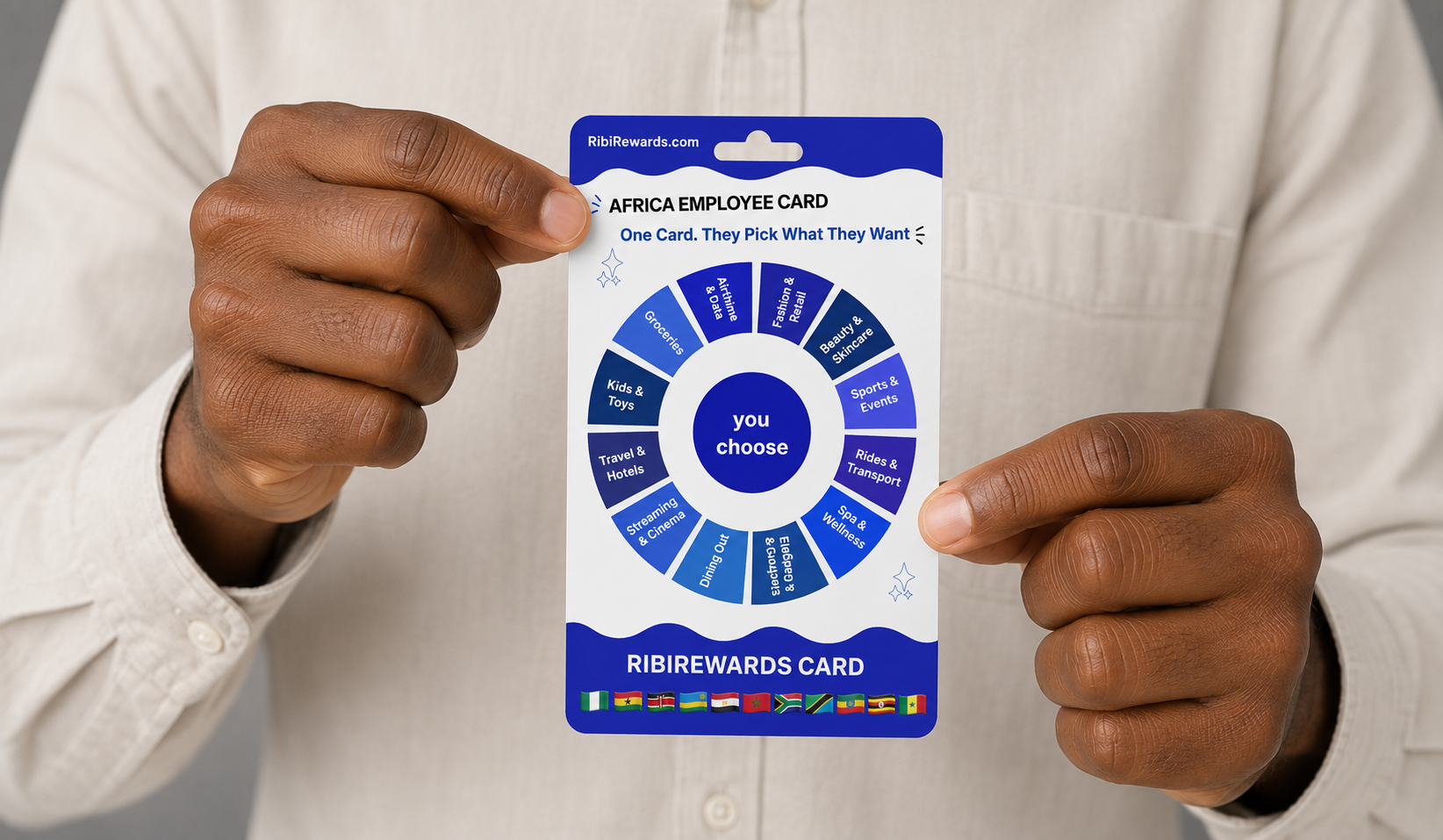
RewardsCard is Africa's rewards and gifting infrastructure in one card — HR teams send it, recipients pick what they actually want from a real catalogue, live across 29 countries. Here's why we built it, and where to find the launch.
 SEASONAL GIFTING
Why December Gifting Planning Should Start in August
Companies that lock in their December gifting plan months ahead get first pick of pricing, delivery slots and card designs. Here's why the scramble every December is avoidable — and what starting early actually looks like.
 CHOICE REWARDS
One Gift, Infinite Choices: Solving Multi-Country December Gifting
Sending the same fruit basket to a team spread across five countries isn't a gift plan. Here's how choice-based rewards let each person pick what actually matters to them, fulfilled properly in their own market.