 Rewards infrastructure for Africa
Employee Benefits in Kenya: What Nairobi Companies Need to Know in 2026
Kenya's talent market is intensely competitive. Here's the complete guide to employee benefits for Kenyan companies — statutory requirements, the five most valued benefits, and more.
Abby Sotomiwa
Co-Founder & CEO, RibiRewards

Employee Benefits in Kenya: What Nairobi Companies Need to Know in 2026
Kenya's talent market is intensely competitive. Here's the complete guide to structuring employee benefits that retain Kenyan professionals in 2026. For more on this, see our piece on Why African Employees Are Choosing Benefits Over Bonuses in 2026.
The Kenyan Talent Market in 2026
Nairobi has established itself as East Africa's premier technology and financial services hub. The talent competition among tech startups, fintechs, NGOs, multinationals, and pan-African companies operating from Nairobi is intense — and Kenyan professionals, increasingly globally connected, are acutely aware of what employers elsewhere offer.
Statutory benefits in Kenya — NSSF contributions, NHIF contributions, and group life insurance — represent a minimum floor that barely differentiates any employer. The benefits that actually move the needle in retention and recruitment sit well above this floor.
Statutory Requirements First
Before building an enhanced benefits programme, ensure compliance with Kenya's statutory requirements. NSSF contributions, the new Social Health Insurance Fund (SHIF) contributions (which replaced NHIF), and WIBA (Work Injury Benefits Act) coverage are mandatory. Consult with a Kenyan employment lawyer to confirm current compliance requirements — these have been evolving rapidly. For more on this, see our piece on Why 78% of African Professionals Say Benefits Influence Their Job Decisions.
What Kenyan Employees Want Most
Health Insurance Enhancement
The transition from NHIF to SHIF has created uncertainty about healthcare coverage. Enhanced private health insurance or HMO top-up contributions are highly valued by Kenyan employees navigating this transition. Comprehensive cover that includes outpatient, inpatient, optical, and dental is the gold standard.
Airtime and Data Bundles
Kenya has high mobile penetration and a culture of M-PESA-mediated financial life. Monthly data and airtime benefits are practical and deeply appreciated — particularly for employees who use mobile internet for work outside office hours or who work remotely. For more on this, see our piece on What Gen Z African Employees Actually Want From Their Benefits Package.
Grocery and Food Benefits
Nairobi's cost of living has risen significantly. Supermarket credits redeemable at Naivas, Carrefour, and Quickmart, alongside food delivery credits on Glovo or Uber Eats, are consistently among the top-requested benefits by Kenyan employees.
Commute Support
The Nairobi matatu system is functional but unreliable. Bolt and Uber credits provide a more reliable commute option for professionals. Companies whose offices are in Westlands, Karen, or Upperhill — accessible primarily by private transport — find that commute benefits are particularly impactful.
Learning and Development
Kenyan professionals have strong international career ambitions. L&D benefits — particularly access to globally recognised certifications — are powerful retention and motivation tools for Kenyan tech and finance talent.
Tax Considerations for Kenyan Benefits
Benefits in kind in Kenya are subject to PAYE under the Income Tax Act. However, certain benefits — including passage benefits, medical benefits, and some training costs — receive more favourable tax treatment. Work with a Kenyan tax advisor to structure your programme for maximum efficiency and compliance.
Building Your Kenyan Benefits Programme
Start with health insurance enhancement and data/airtime bundles — these have the fastest impact and broadest appreciation across demographics. Add meal and transport credits next. Layer in L&D and lifestyle benefits as your programme matures.
RibiRewards operates across Kenya with local vendor relationships in Nairobi, Mombasa, and Kisumu. Benefits are delivered digitally with physical options available in major urban centres.
Related reading
Abby Sotomiwa
Co-Founder & CEO, RibiRewards
Building rewards and recognition infrastructure for African and diaspora markets.
Africa HR Insights
100 chart-driven data reports on employee rewards, recognition benchmarks, and year-end gifting across African markets — published weekly by RibiRewards.
Ready to start rewarding your team properly?
One dashboard, every African market, every reward type. Book a 20-minute call and we'll tailor the platform to your team.
 PRODUCT
We Just Launched RewardsCard on Product Hunt
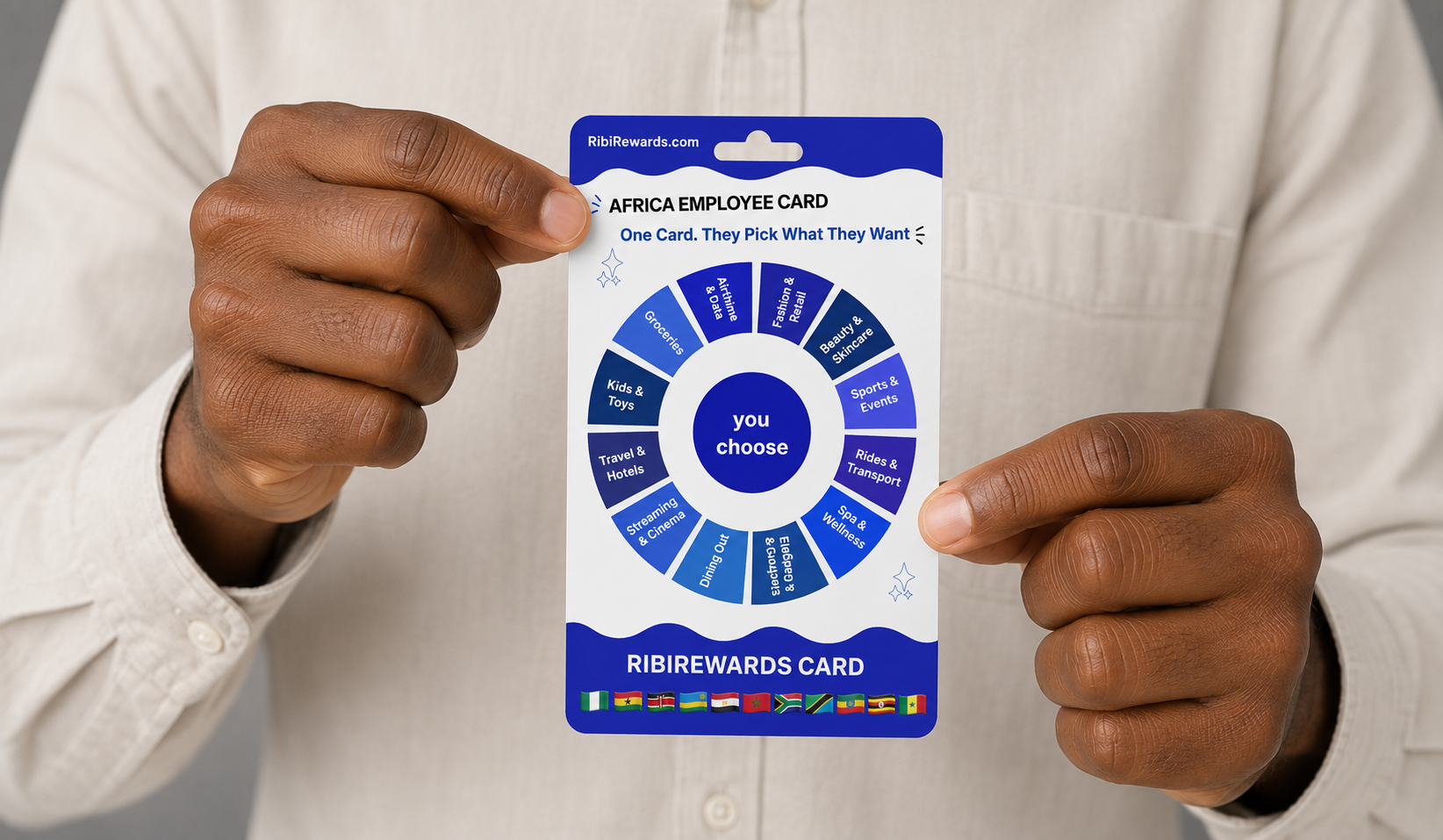
RewardsCard is Africa's rewards and gifting infrastructure in one card — HR teams send it, recipients pick what they actually want from a real catalogue, live across 29 countries. Here's why we built it, and where to find the launch.
 SEASONAL GIFTING
Why December Gifting Planning Should Start in August
Companies that lock in their December gifting plan months ahead get first pick of pricing, delivery slots and card designs. Here's why the scramble every December is avoidable — and what starting early actually looks like.
 CHOICE REWARDS
One Gift, Infinite Choices: Solving Multi-Country December Gifting
Sending the same fruit basket to a team spread across five countries isn't a gift plan. Here's how choice-based rewards let each person pick what actually matters to them, fulfilled properly in their own market.