 Rewards infrastructure for Africa
How to Build an Employee Benefits Programme from Scratch: The Step-by-Step Guide for African Companies
No benefits programme yet? Here's the complete step-by-step playbook — from needs assessment to launch — for HR teams building their first structured African benefits programme.
Abby Sotomiwa
Co-Founder & CEO, RibiRewards

How to Build an Employee Benefits Programme from Scratch: The Step-by-Step Guide for African Companies
No benefits programme yet? No problem. Here's the complete playbook — from needs assessment to launch — for HR teams building their first structured benefits programme in an African context. For more on this, see our piece on Why 78% of African Professionals Say Benefits Influence Their Job Decisions.
Start Here: The Four Principles
Before diving into the steps, anchor your thinking around four principles that determine whether an African benefits programme succeeds or fails:
- Relevance beats generosity: A ₦10,000 benefit your team actually uses beats a ₦25,000 benefit that misses the mark.
- Consistency builds trust: A modest benefit delivered reliably every month builds more loyalty than an unpredictable larger benefit.
- Communication is half the product: Employees can't value what they don't know about or understand.
- Infrastructure enables scale: Build on a platform from day one so administration doesn't become a bottleneck as you grow.
Step 1: Conduct a Benefits Needs Assessment
Don't guess what your team needs — ask them. A simple five-question anonymous survey asking employees to rank their top three benefit priorities, identify their most significant daily financial pressures, and describe what would most improve their working life gives you the data to build a relevant programme rather than a generic one.
Run the survey in the channel your team actually uses — WhatsApp, Google Forms via email, or Slack. Aim for 70%+ response rate before drawing conclusions. Segment the results by department, seniority, and location if your team is distributed — the priorities will differ.
Step 2: Define Your Budget
Benefits budget is typically expressed as a percentage of payroll (excluding statutory contributions). Start with what's sustainable: a programme you can maintain and grow is more valuable than a generous launch that gets cut six months later.
A reasonable starting point for most African companies is 8–12% of payroll. This funds a core programme across three to four categories without overextending. As the programme demonstrates ROI through improved retention and engagement, the case for budget expansion becomes self-funding.
Step 3: Choose Your Benefit Categories
Use your needs assessment data to select the categories that map to your team's expressed priorities. Most African companies starting their first benefits programme should focus on three to four categories rather than trying to cover everything:
- High-impact foundation: Health (HMO top-up or basic plan) + Meal allowance
- Daily life support: Transport and commute credits (for office teams) or data bundles (for remote)
- Growth and engagement: L&D stipend
- Add next: Family and lifestyle benefits as budget allows
Step 4: Choose Fixed, Flexible, or Hybrid Structure
Decide whether to offer fixed benefits (everyone gets the same allocation per category) or a flexible wallet (employees allocate a budget across categories of their choice). For first-time programmes with under 100 employees, fixed benefits are simpler to launch. For larger or more diverse teams, a flexible wallet drives higher utilisation and satisfaction.
A hybrid model — fixed core benefits plus a discretionary flexible budget — often works best as a programme matures.
Step 5: Select Your Platform
Manual benefits administration — spreadsheets, individual vendor relationships, receipt management — does not scale. Choose a benefits platform before you launch, not after. Key criteria for African companies evaluating benefits platforms:
- Pan-African market coverage (not just one country)
- Digital-first delivery with physical options where needed
- Local vendor network with reliable redemption
- Real-time spend reporting and utilisation analytics
- Integration capability with your existing HRIS
- Responsive support (time zones matter)
Step 6: Design Your Communication Plan
Plan your benefits communication before you launch, not as an afterthought. You need: a launch communication (all-hands or company-wide message from leadership), an onboarding process that includes benefits orientation, monthly statements or reminders, and a manager briefing so line managers can reinforce the programme.
Write a "total compensation statement" template that combines salary and benefits into a single figure — use this in offer letters and annual reviews. Employees who see the full value are more likely to account for it in their employer assessment.
Step 7: Launch and Measure
Launch with visible energy — a leadership communication that frames benefits as a signal of the company's commitment to its people, not just a payroll line item. Then measure from day one: utilisation rate per category, employee satisfaction scores (before and after), and over a 6–12 month horizon, attrition rate and recruitment metrics.
Review the programme every six months. Drop under-utilised benefits and reinvest in high-utilisation categories. Add categories as budget grows. Keep the communication fresh — a programme that launched with fanfare two years ago needs periodic re-communication to remain visible and valued.
RibiRewards: Your Benefits Infrastructure Partner
RibiRewards is purpose-built for African companies building and scaling employee benefits programmes. Our platform covers all five major benefit categories across Nigeria, Kenya, Ghana, South Africa, Rwanda, and beyond — with digital delivery, local vendor relationships, and the analytics your HR and finance teams need to prove ROI. For more on this, see our piece on What Gen Z African Employees Actually Want From Their Benefits Package.
Getting started takes less than 24 hours. Book a demo and we'll walk you through building a programme tailored to your team's specific context, size, and budget.
Related reading
Abby Sotomiwa
Co-Founder & CEO, RibiRewards
Building rewards and recognition infrastructure for African and diaspora markets.
Africa HR Insights
100 chart-driven data reports on employee rewards, recognition benchmarks, and year-end gifting across African markets — published weekly by RibiRewards.
Ready to start rewarding your team properly?
One dashboard, every African market, every reward type. Book a 20-minute call and we'll tailor the platform to your team.
 PRODUCT
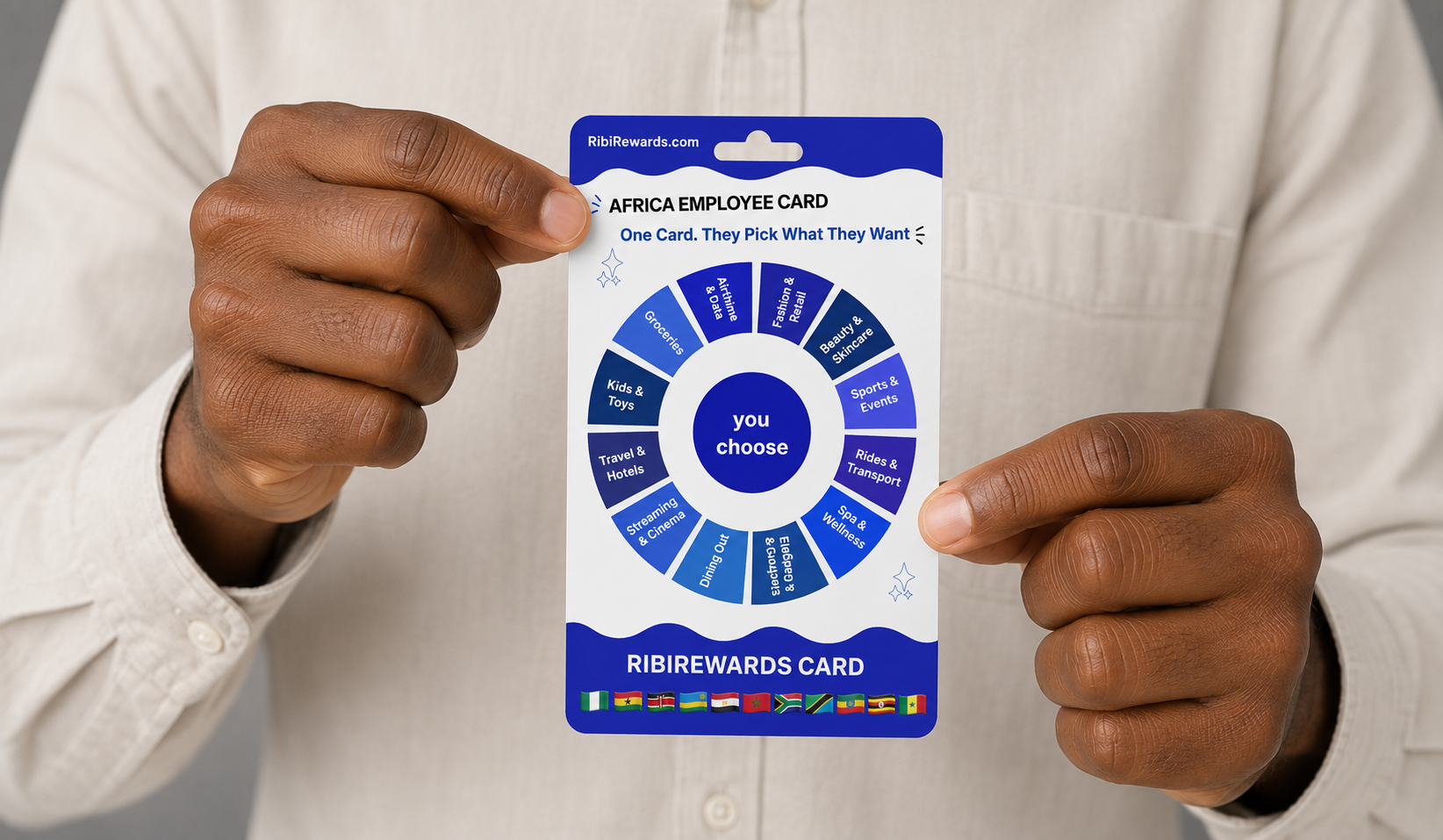
We Just Launched RewardsCard on Product Hunt
RewardsCard is Africa's rewards and gifting infrastructure in one card — HR teams send it, recipients pick what they actually want from a real catalogue, live across 29 countries. Here's why we built it, and where to find the launch.
 SEASONAL GIFTING
Why December Gifting Planning Should Start in August
Companies that lock in their December gifting plan months ahead get first pick of pricing, delivery slots and card designs. Here's why the scramble every December is avoidable — and what starting early actually looks like.
 CHOICE REWARDS
One Gift, Infinite Choices: Solving Multi-Country December Gifting
Sending the same fruit basket to a team spread across five countries isn't a gift plan. Here's how choice-based rewards let each person pick what actually matters to them, fulfilled properly in their own market.