 Rewards infrastructure for Africa
How to Prove the ROI of Employee Benefits to Your Finance Team (African Edition)
Finance teams demand ROI evidence for people investment. Here's the framework African HR leaders use to quantify benefits ROI and win budget approval.
Abby Sotomiwa
Co-Founder & CEO, RibiRewards

How to Prove the ROI of Employee Benefits to Your Finance Team (African Edition)
Finance teams across African companies are demanding ROI evidence for people investment. Here's the framework HR leaders use to make the numbers tell the story.
The Finance Team Is Not the Enemy
When the CFO pushes back on benefits spend, it's rarely because they don't care about people. It's because they need to make difficult capital allocation decisions with limited budgets. They're asking a reasonable question: "Is this the best use of this money?"
HR leaders who answer with "it's important for culture" lose this conversation. HR leaders who answer with numbers win it — and build more sustainable programmes as a result.
The Core ROI Model for Employee Benefits
The return on employee benefits investment has three main components, all of which are quantifiable:
1. Attrition Cost Reduction
The cost of replacing an employee in an African company varies by role, but a reasonable estimate across most functions is 50–150% of annual salary. This includes recruitment fees, onboarding time, productivity loss during the gap, and the cost of institutional knowledge walking out the door.
If a structured benefits programme retains even 5% more of your team annually, the maths are usually straightforward. A 100-person company with average salaries of ₦3M per year, losing one fewer engineer to attrition, saves a minimum of ₦1.5M in replacement costs. A comprehensive benefits programme costs a fraction of that.
2. Productivity and Presenteeism Gains
Employees under financial stress, health anxiety, or commute burden are not fully present at work. Research consistently shows that financial wellness benefits reduce productivity-draining distraction by 15–25%. For knowledge workers, even modest productivity gains compound rapidly across a team.
3. Recruitment Cost Reduction
Strong benefits packages improve offer acceptance rates and reduce time-to-hire. In a competitive market, companies with well-communicated benefits packages close candidates faster and with fewer counter-offer losses. Recruitment agency fees in Nigeria typically run 15–25% of annual salary — reducing recruitment events by even 20% saves significant budget.
Building Your Benefits ROI Dashboard
The metrics that make the case to finance are:
- Attrition rate: before and after benefits programme launch
- Time-to-hire: tracking whether recruitment is becoming faster or slower
- Offer acceptance rate: tracking whether candidates are accepting offers at higher rates
- Employee engagement score (eNPS): tracking whether engagement is improving
- Sick days: tracking whether health benefits are reducing absenteeism
- Benefits utilisation rate: tracking whether the investment is being received
A Simple Case Study Format
When presenting to finance, use this format: "Before we launched the benefits programme, our annualised attrition rate was X%. In the 12 months since launch, it has fallen to Y%. Based on average replacement cost of ₦Z per employee, this represents a saving of ₦[saving] — against a total benefits programme cost of ₦[cost]. The programme has paid for itself [multiple]× over." For more on this, see our piece on The ROI of Employee Recognition: What Finance Actually Needs to See.
Combine this with qualitative evidence — engagement survey improvements, recruiter feedback on offer acceptance — and the case is usually compelling.
Using RibiRewards Data for ROI Reporting
The RibiRewards analytics dashboard provides utilisation data, spend by category, and employee-level benefit consumption — making it straightforward to build the reporting narrative finance teams need. The data exists; it just needs to be connected to the business outcomes it's driving.
Related reading
Abby Sotomiwa
Co-Founder & CEO, RibiRewards
Building rewards and recognition infrastructure for African and diaspora markets.
Africa HR Insights
100 chart-driven data reports on employee rewards, recognition benchmarks, and year-end gifting across African markets — published weekly by RibiRewards.
Ready to start rewarding your team properly?
One dashboard, every African market, every reward type. Book a 20-minute call and we'll tailor the platform to your team.
 PRODUCT
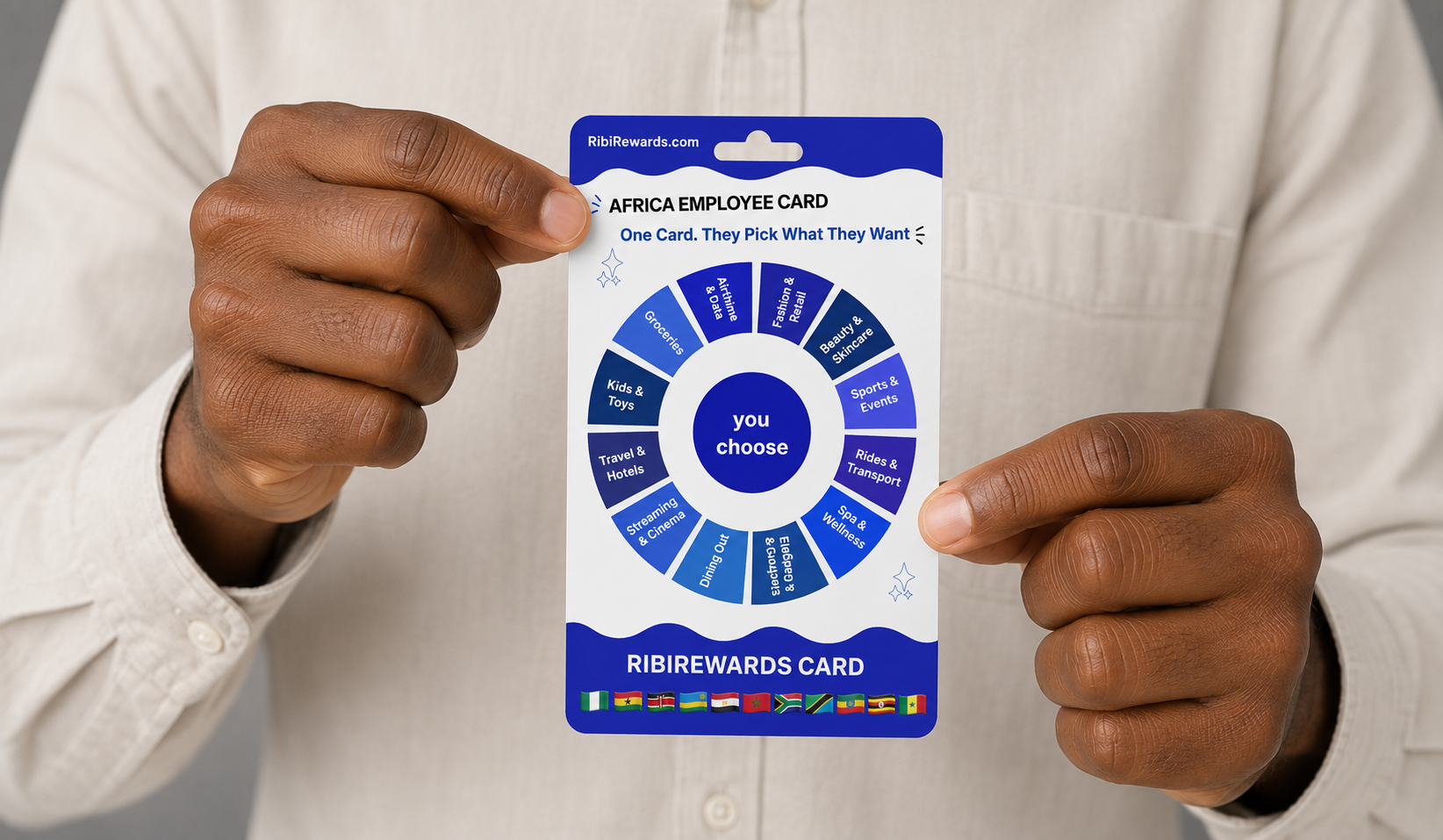
We Just Launched RewardsCard on Product Hunt
RewardsCard is Africa's rewards and gifting infrastructure in one card — HR teams send it, recipients pick what they actually want from a real catalogue, live across 29 countries. Here's why we built it, and where to find the launch.
 SEASONAL GIFTING
Why December Gifting Planning Should Start in August
Companies that lock in their December gifting plan months ahead get first pick of pricing, delivery slots and card designs. Here's why the scramble every December is avoidable — and what starting early actually looks like.
 CHOICE REWARDS
One Gift, Infinite Choices: Solving Multi-Country December Gifting
Sending the same fruit basket to a team spread across five countries isn't a gift plan. Here's how choice-based rewards let each person pick what actually matters to them, fulfilled properly in their own market.