 Rewards infrastructure for Africa
Meal Allowances in Africa: The HR Guide to Feeding Your Team Without the Admin Chaos
How African companies can implement meal benefits that employees actually use — without vendor management headaches or payroll complexity.
Abby Sotomiwa
Co-Founder & CEO, RibiRewards

Meal Allowances in Africa: The HR Guide to Feeding Your Team Without the Admin Chaos
How African companies can implement meal benefits that employees actually use — without vendor management headaches or payroll complexity. For more on this, see our piece on Mental Health Benefits Are No Longer Optional for African Companies. Here's Why — and How to Start..
Why Meal Benefits Hit Different in Africa
Food is central to African workplace culture in a way that's different from many other regions. The communal lunch, the shared plate, the office canteen banter — eating together is part of how teams bond. When an employer invests in employees' daily meals, it touches something culturally resonant, not just financially convenient.
But beyond culture, there's a hard economic reality: food inflation across Nigeria, Kenya, Ghana, and South Africa has made daily meals a meaningful financial burden for many employees. A structured meal allowance isn't just a perk — it's direct relief from a cost that employees feel every single day.
The Four Models of Meal Benefits
1. In-Office Canteen or Catering Subsidy
The traditional model: the company provides or subsidises an on-site canteen. Works well for larger companies with single-site operations. The challenge in African cities is logistics — reliable catering in Lagos or Nairobi is genuinely hard to manage, and quality varies enormously.
2. Restaurant Vouchers
Digital vouchers redeemable at local restaurants, eateries, and fast food outlets. Popular because employees have choice and the company doesn't need to manage any catering infrastructure. The challenge historically has been managing the vendor network and ensuring redemption works reliably.
3. Food Delivery Credits
Credits loaded onto food delivery apps (Chowdeck, Glovo, Uber Eats) for employees to order from their preferred restaurants. Particularly popular with remote and hybrid teams who aren't in office. Works well in cities with strong delivery infrastructure.
4. Grocery and Supermarket Allowances
Monthly grocery credits that employees use at supermarkets and retail chains. Most appreciated by employees who prefer to manage their own meals rather than eating out, and by those with dietary restrictions or family responsibilities.
The Admin Problem (And How to Solve It)
The reason many African companies haven't implemented structured meal benefits isn't lack of desire — it's operational complexity. Managing multiple vendor relationships, tracking spend, handling failed redemptions, processing receipts, reporting to finance — it adds up to significant HR overhead.
The solution is a unified benefits platform that handles vendor relationships, digital delivery, and spend reporting as a service. Instead of your HR team managing a dozen vendor relationships, you configure the benefit once and the platform handles execution across all supported restaurants, delivery apps, and supermarkets in your employees' cities.
What to Budget for Meal Benefits
Across Nigerian companies, the typical meal allowance ranges from ₦5,000 to ₦25,000 per month depending on role level and company size. Kenyan equivalents typically range from KES 2,000 to KES 8,000. These figures represent meaningful daily support — at the lower end, roughly covering two to three meals per week from local eateries.
Start with a budget you can sustain and communicate clearly to employees. Consistency matters more than generosity — a reliable ₦8,000 monthly allowance builds more trust than an unpredictable ₦20,000 that appears three months out of twelve.
City-by-City Considerations
- Lagos: Food delivery infrastructure is strong. Restaurant vouchers and Jumia/Bolt credits are popular. Canteen logistics are complex — digital delivery wins.
- Abuja: More suburban layout makes restaurant vouchers effective. Several high-quality eateries are partner-ready.
- Nairobi: Strong food delivery ecosystem. Canteen culture is embedded in many corporate offices. Supermarket allowances popular with families.
- Accra: Growing delivery infrastructure. Restaurant vouchers work well in the central business district and East Legon. Supermarket credits widely appreciated.
- Johannesburg/Cape Town: More developed food delivery market. Supermarket allowances popular across all demographics.
Making It Work for Remote Teams
For distributed teams, grocery allowances and food delivery credits are the most practical meal benefit options — they work regardless of where an employee is located. Ensure your benefits platform supports multiple cities and states, not just your HQ location.
With RibiRewards, meal benefits are configured centrally but delivered locally — meaning an employee in Port Harcourt gets the same benefit quality as a colleague in Victoria Island, Lagos.
Related reading
- Transport Benefits in African Cities: How to Take the Commute Burden Off Your Team
- School Fees, Childcare, and Family Benefits: The African Employee Benefit That Creates the Deepest Loyalty
- Mental Health Benefits Are No Longer Optional for African Companies. Here's Why — and How to Start.
- Meal Allowances, Transport, and Wellness: The Everyday Benefits African Employees Value Most
Abby Sotomiwa
Co-Founder & CEO, RibiRewards
Building rewards and recognition infrastructure for African and diaspora markets.
Africa HR Insights
100 chart-driven data reports on employee rewards, recognition benchmarks, and year-end gifting across African markets — published weekly by RibiRewards.
Ready to start rewarding your team properly?
One dashboard, every African market, every reward type. Book a 20-minute call and we'll tailor the platform to your team.
 PRODUCT
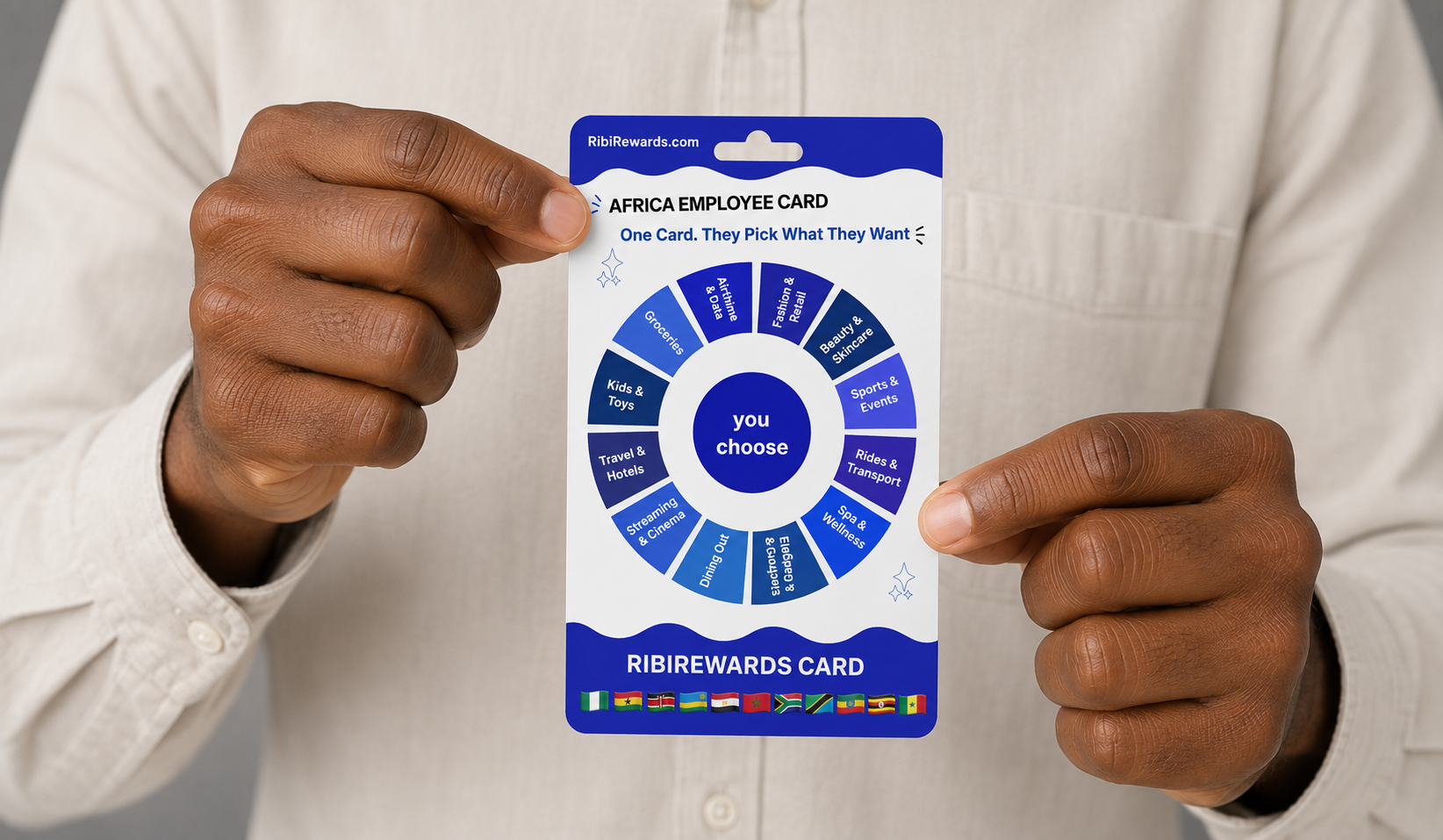
We Just Launched RewardsCard on Product Hunt
RewardsCard is Africa's rewards and gifting infrastructure in one card — HR teams send it, recipients pick what they actually want from a real catalogue, live across 29 countries. Here's why we built it, and where to find the launch.
 SEASONAL GIFTING
Why December Gifting Planning Should Start in August
Companies that lock in their December gifting plan months ahead get first pick of pricing, delivery slots and card designs. Here's why the scramble every December is avoidable — and what starting early actually looks like.
 CHOICE REWARDS
One Gift, Infinite Choices: Solving Multi-Country December Gifting
Sending the same fruit basket to a team spread across five countries isn't a gift plan. Here's how choice-based rewards let each person pick what actually matters to them, fulfilled properly in their own market.