 Rewards infrastructure for Africa
Transport Benefits in African Cities: How to Take the Commute Burden Off Your Team
Lagos traffic, Nairobi matatus, Accra go-slows — African commutes are brutal. Here's how to use transport benefits strategically across Nigeria, Kenya, Ghana, and South Africa.
Abby Sotomiwa
Co-Founder & CEO, RibiRewards

Transport Benefits in African Cities: How to Take the Commute Burden Off Your Team
Lagos traffic. Nairobi matatus. Accra go-slows. African commutes are genuinely brutal — and smart companies are turning transport benefits into a loyalty tool.
The Commute Tax on African Workers
The Lagos commuter spends, on average, between two and four hours in transit daily. The Nairobi equivalent isn't far behind. In Accra and Johannesburg, depending on location, commutes can easily consume three or more hours of a person's day. That's time taken from sleep, family, health, and recovery — and it's paid for entirely by the employee.
Transport costs also represent a significant slice of take-home pay. A junior professional in Lagos spending ₦3,000 to ₦5,000 daily on ride-hailing or danfo fares is losing ₦60,000 to ₦100,000 monthly just to get to a job that pays them. The maths are brutal, and employees know it.
Why Digital Transport Credits Are the Answer
Cash transport allowances are common but problematic. They're taxable as income. They're untracked. And they can be spent on anything — including not commuting. Digital transport credits, by contrast, are purpose-specific, trackable, and often more tax-efficient depending on jurisdiction.
When employees receive Bolt credits or BRT top-ups directly in their RibiRewards wallet, they use them for transport. Spend is visible. HR teams can report on utilisation without chasing receipts. And employees feel the benefit specifically where it was intended.
The Remote Work Data Dimension
For remote and hybrid teams, transport benefits take a different form: data bundles. In African markets where broadband penetration is still growing and fixed-line internet is unreliable, monthly data credits for mobile internet access are a genuine lifeline for remote employees. A remote engineer in Ibadan or Kisumu who receives a monthly data bundle credit experiences a direct, daily improvement in their ability to do their job. For more on this, see our piece on School Fees, Childcare, and Family Benefits: The African Employee Benefit That Creates the Deepest Loyalty.
Forward-thinking companies are expanding their transport and commute benefit category to include connectivity — recognising that "getting to work" increasingly means "getting online."
City-Specific Transport Benefit Strategies
- Lagos: Prioritise Bolt/Uber credits for proximity commutes; BRT top-ups for longer routes. Consider fuel allowances for employees who drive.
- Abuja: Ride-hailing credits are most effective; the city's road layout makes this the dominant commute mode for professionals.
- Nairobi: Matatu payments via M-PESA integration, Bolt credits for professionals, and data bundles for hybrid workers.
- Accra: Ride-hailing credits combined with fuel allowances work well; Trotro is less formalised for digital payments.
- Johannesburg/Cape Town: Fuel allowances dominant given car-centric urban design; MyCiti bus credits in Cape Town.
Sizing the Transport Benefit
A meaningful transport benefit covers 30–60% of an employee's actual commute cost. For Lagos-based professionals, this typically means ₦15,000 to ₦40,000 per month depending on distance and mode. For Nairobi, KES 3,000 to KES 8,000. For remote workers, a data bundle of 20GB to 50GB per month covers most professional needs.
Even partial coverage of commute costs is felt immediately and appreciated deeply. It's one of the highest-impact, lowest-complexity benefits you can add to your programme.
Related reading
- School Fees, Childcare, and Family Benefits: The African Employee Benefit That Creates the Deepest Loyalty
- Mental Health Benefits Are No Longer Optional for African Companies. Here's Why — and How to Start.
- Meal Allowances, Transport, and Wellness: The Everyday Benefits African Employees Value Most
- Meal Allowances in Africa: The HR Guide to Feeding Your Team Without the Admin Chaos
Abby Sotomiwa
Co-Founder & CEO, RibiRewards
Building rewards and recognition infrastructure for African and diaspora markets.
Africa HR Insights
100 chart-driven data reports on employee rewards, recognition benchmarks, and year-end gifting across African markets — published weekly by RibiRewards.
Ready to start rewarding your team properly?
One dashboard, every African market, every reward type. Book a 20-minute call and we'll tailor the platform to your team.
 PRODUCT
We Just Launched RewardsCard on Product Hunt
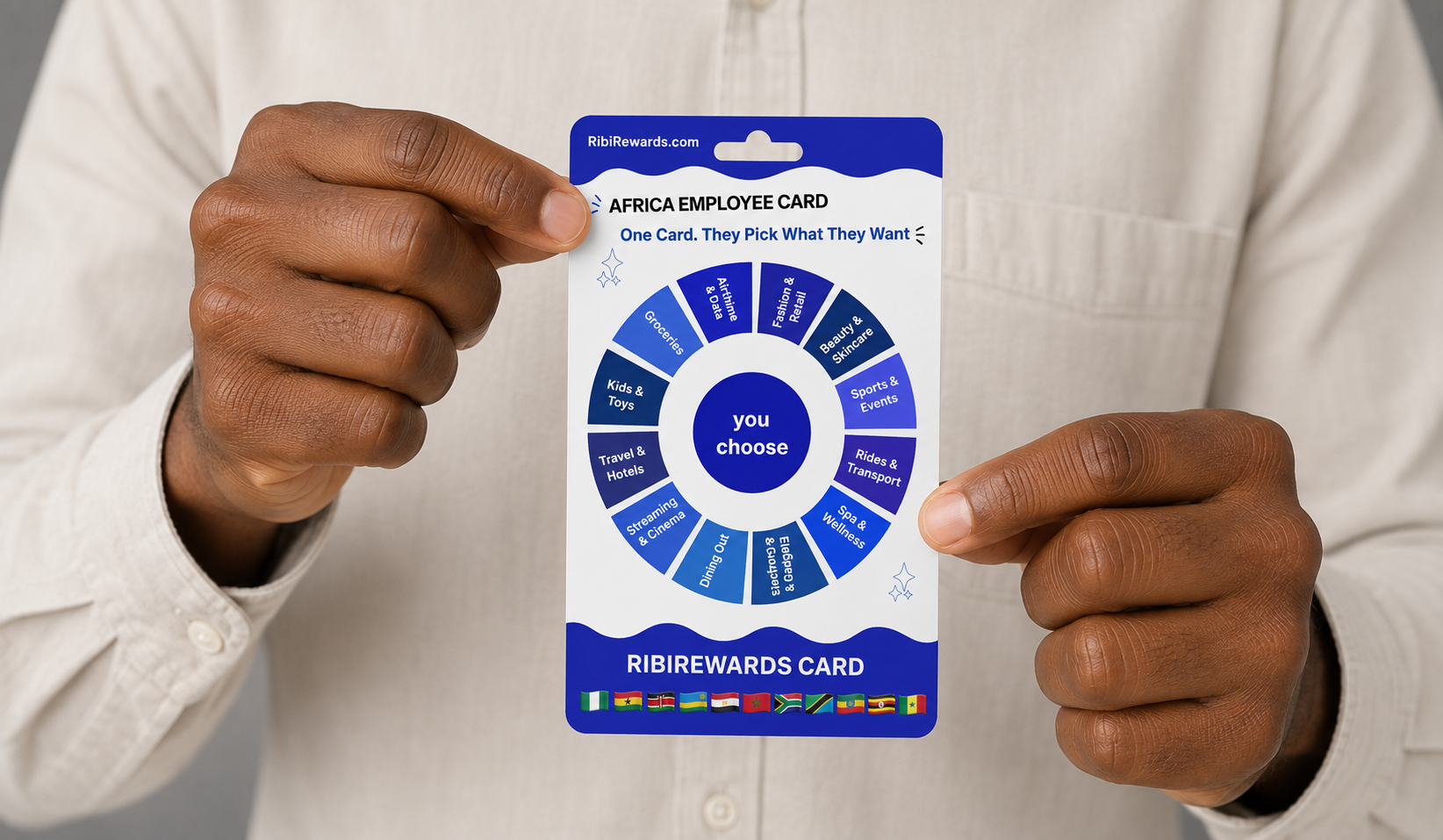
RewardsCard is Africa's rewards and gifting infrastructure in one card — HR teams send it, recipients pick what they actually want from a real catalogue, live across 29 countries. Here's why we built it, and where to find the launch.
 SEASONAL GIFTING
Why December Gifting Planning Should Start in August
Companies that lock in their December gifting plan months ahead get first pick of pricing, delivery slots and card designs. Here's why the scramble every December is avoidable — and what starting early actually looks like.
 CHOICE REWARDS
One Gift, Infinite Choices: Solving Multi-Country December Gifting
Sending the same fruit basket to a team spread across five countries isn't a gift plan. Here's how choice-based rewards let each person pick what actually matters to them, fulfilled properly in their own market.